Tracing inclusivity: Contribution of the Dutch private sector to inclusive development in Kenya
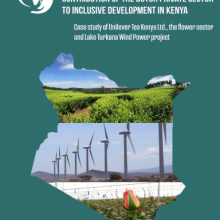
Tracing inclusivity: Contribution of the Dutch private sector to inclusive development in Kenya
Foreign companies operating in a ‘host’ country’s private sector play an important role in fostering inclusive development in these nations. This PhD thesis, exploring the contributions of the Dutch private sector to inclusive development in Kenya’s three most important sectors, tea, flower and renewable energy, finds that private companies operate in a very specific context and must adapt to existing local circumstances that are often not automatically inclusive.
Foreign companies operating in a ‘host’ country’s private sector play an important role in fostering inclusive development in these nations by stimulating economic growth and trade, creating jobs and reducing poverty and inequalities in five dimensions (economic, socio-cultural, spatial, ecological and political). Many of these companies even receive support from their home governments through Private Sector Development (PSD) policies and initiatives as part of their Official Development Assistance (ODA).
This PhD thesis, exploring the contributions of the Dutch private sector to inclusive development in Kenya’s three most important sectors, tea, flower and renewable energy, finds that private companies operate in a very specific context and must adapt to existing local circumstances that are often not automatically inclusive. Foreign companies must be mindful of the historical, social and economic contexts, particularly underlying political economy and power relations of their ‘host’ country, as they shape patterns of inclusion and exclusion of the private sector there. Thus, companies must appropriately factor these dynamics into their planning and expected results. If such dynamics are ignored, foreign companies fail to reach their full inclusiveness potential and may even reinforce non-inclusive systems. Moreover, to avoid this, the author argues that Private Sector Development (PSD) supportive policies and oversight of both ‘home’ and ‘host’ countries play a key function.
Based on the PhD thesis’ findings, the author formulates a series of recommendations for foreign companies to strengthen their potential contribution to inclusive development in their ‘host’ country:
- Foreign companies should seek local support when entering the ‘host’ country’s market from their embassy and mentorship from business(wo)men from their home country that have experience of doing business in the ‘host’ nation’s markets.
- Foreign companies can adjust their business models to account for greater inclusive development outcomes, including productive employment creation, and should undertake internal actions to deeply understand their local context and stakeholders.
- Moreover, these foreign companies should increase their involvement with local sector’s trade unions, associations and forms of national public–private dialogues in these countries to strengthen the voice of the private sector and civil society in designing and developing national economic strategies for a more inclusive national system, including national standard compliance mechanisms.
- Foreign companies should invest in training to promote the development of their employees.
For more information on the specific contribution of the Dutch private sector to inclusive development in Kenya’s tea, flower and renewable energy sectors, please read the PhD thesis Tracing inclusivity. This thesis forms part of a larger research project entitled “Dutch Multinational Businesses, Dutch government and the promotion of productive employment in Sub-Sahara Africa: a comparative study of Kenya and Nigeria”, as part of the research agenda of the Knowledge Platform on Inclusive Development Policies (INCLUDE), funded by the Ministry of Foreign Affairs through NWO-WOTRO.